
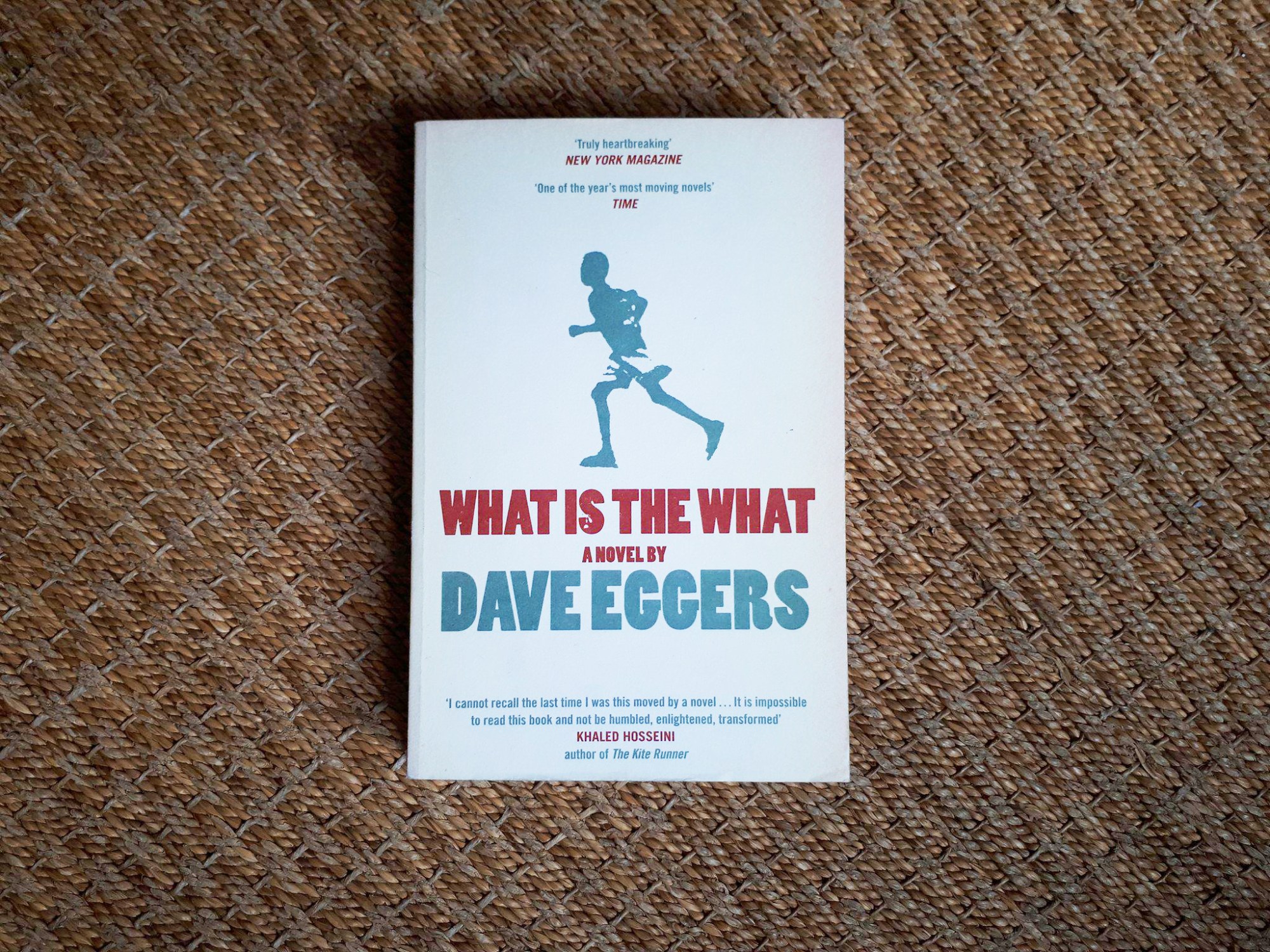
After the death of 2-year-old refugee child Mawda, I decided to post a presentation I gave 10 years ago on trauma in What Is the What by Dave Eggers, and the importance of empathy.
What Is the What is a biographical novel by Dave Eggers, based on the events of Valentino Achak Deng’s childhood during the Civil War in Sudan and his consequent living in refugee camps in Ethiopia and Kenya and eventual resettlement to the United States. I am not going to expand on the political history of cultural division and friction in Sudan between the Islamite Arabs in the north (Baggara or murahaleen) and the Catholic black Dinka and Nuer in the south (the title What Is the What refers to the story of creation told by the Dinka that designates the Arabs as inferior). My main focus will thus be on the traumatic events rendered in the novel and the way the protagonist deals with these.
 Let’s first have a look at a definition of trauma. According to Cathy Caruth,
post-traumatic stress disorder is “a response, sometimes delayed, to an overwhelming event or events, which takes the form of repeated, intrusive hallucinations, dreams, thoughts or behaviors stemming from the event, along with numbing that may have begun during or after the experience, and possibly also increased arousal to (and avoidance of) stimuli recalling the event”.
LaCapra, however, slightly disagrees and distinguishes three types of dealing with trauma: denial, acting-out, and working-through. Applied to the Sudanese case, the mode of denial, characterized by totalizing narratives which exclude, marginalize, or normalize trauma, can be seen in the Western habit of associating the conflict merely with the city of Darfur – because this city has in recent years appeared in the television news – and consequently neglecting the preceding twenty years of genocide.
The phase of acting-out is amply illustrated by the accounts of Valentino: he is haunted by the past and compulsively relives the traumatic events; therefore, the distinction between past and present disappears and leaves no way out for a different future. As Caruth claims, the past events reappear against his will: Valentino has uncontrolled repetitive hallucinations while facing random people in Atlanta. What’s remarkable is the precision of details in these current flashbacks, especially compared to the difficulties Valentino experiences when first having to write down the story of his youth: he forgets or deems irrelevant certain key events. This numbness persists even at a later age in Atlanta: his memory functions less optimal than before and he suffers from persisting severe headaches.
Valentino literally reflects the definition of trauma, which originally denoted a physical injury, and only later on also characterized a psychic wound. He associates the scar on his leg, wounded by running into barbed wire, with the tragic events happening at those days, like his having to watch boys of his age, and often old friends, die from starvation. A similar association can be found in the wound inflicted by Powder, an African-American gangster breaking into Valentino’s flat in Atlanta. Although he has escaped the war in Sudan, he is still not safe in his saving country America. His head wound, caused by a slap of Powder’s gun, increases his headaches and serve to remind him of past atrocities, which he compares with – and often prefers over! – his present situation. At this point in the novel, one is inclined to consider the impossibility of renewal and regeneration, characteristic of the method of acting-out.
Another characteristic feature to this respect is Valentino’s death drive, a term coined by Freud in his Beyond the Pleasure Principle. Frequently during his exodus of Sudan, Valentino encounters little boys or adults giving up, simply laying down and waiting to die, or surrendering to enemy forces. Valentino himself, at a certain point, almost gives up. When walking from Pinyudo, an Ethiopian refugee camp, to Kakuma, the Kenyan refugee camp, his eyes are infected with “nyintok”, which renders him almost blind. Moreover, it has been a while since he last saw his partner in misfortune Achor Achor dehydrated in a medical tent, so he fears this friend will be dying too. He stops walking and lies down, convinced to die soon, but a girl passing by, Maria, urges him to stand up and keep going.
The third option described by LaCapra, working-through, allows one to gain a critical distance towards the past, therefore one doesn’t constantly have to be fixated on the event. Because the victim can distinguish between the past and the present, he can build towards a future. He mentions narrative renderings of the events as one of the key factors in getting over the traumatic past. At the end of the novel, Valentino says:
“Whatever I do, however I find a way to live, I will tell these stories. (…) It gives me strength, almost unbelievable strength, to know that you are there. I covet your eyes, your ears, the collapsible space between us. How blessed are we to have each other? I am alive and you are alive so we must fill the air with our words. I will fill today, tomorrow, every day until I am taken back to God. I will tell stories to people who will listen and to people who don’t want to listen, to people who seek me out and to those who run.” (Eggers, Dave. 2006. What Is the What. Penguin Books, London. 2007: 474-5)
He has gained linguistic control over his pain, and can thus start to recover from his traumas. Cathy Caruth claims that the capacity to tell slightly different stories eventually enables the narrator to forget them, which is an essential part of the cure. Valentino relates how, during the resettlement procedures, which consist of interviews and autobiographies to be handed in, many fellow-refugees exaggerate their stories to secure a flight to America: all had suddenly faced lions and crocodiles, or had seen their parents being killed before their eyes. This raises the question as to whether oral or written testimonies can be considered historically correct and objective. Besides, many of the Lost Boys were former soldiers of the Red Army, or “seeds” for the SPLA (Sudan People’s Liberation Army). Because one had to choose sides between being assaulted by Sudanese rebels or suffering from reprisal action from the government army, the distinction between victim and aggressor often proves to be a difficult one.
Valentino, on the other hand, stresses the truth of his accounts, out of which Dave Eggers eventually compiled the novel. He highlights the collective experience of these two and a half million fellow-Sudanese. In a preface to the novel, he explains:
“Because many of the passages are fictional, the result is called a novel. It should not be taken as a definitive history of the civil war in Sudan, nor of the Sudanese people, nor even of my brethren, those known as the Lost Boys. This is simply one man’s story, subjectively told. And though it is fictionalized, it should be noted that the world I have known is not so different from the one depicted within these pages. We live in a time when even the most horrific events in this book could occur, and in most cases did occur.”
However, once settled in America, their problems are far from over. Apart from the difficulties in adjusting to the western culture and finding respectable jobs, refugees often suffer from identity crises. WEB DuBois calles it a “double consciousness”: one’s identity is always conceived through the eyes of others, who look on in amused contempt and pity. They have a multiple ethnicity, both Sudanese and American, and are said to keep in frequent contact with their fellow-countrymen, often marrying only within their culture, and sending back money to relatives in the home country. As Kalí Tal states, they assimilate through the participation of equals.
Besides being engaged in Sudanese committees all over the country, Valentino tells the story of his life to many white or latino Americans as well. Mary Williams and Anne and Gerald Newton are active to defend the Sudanese cause. Valentino finds his own personal benefactors, who help him adapt to the cultural habits, in Bobby Newmyer and Phil Mays. Especially with the last one he spends a lot of time telling his childhood events. This provokes in Phil what is called secondary traumatisation: the trauma is almost re-experienced by the listeners when told:
“(…) I told Phil a brief version of my story. I could see that it affected him deeply. He had read about the Lost Boys in the newspaper, but hearing my more detailed version upset him.” (158) “He sat down, behind the wheel, put his hands in his lap and he cried. I watched his shoulders shake, watched him bring his hands to his face.” (159)
Caruth, however, insists on the ethical value of bearing witness to trauma: it can create the grounds for new forms of community, build a bridge between different cultures and their disparate historical experiences. After listening to Valentino’s accounts, Phil decides to do everything he can to help him:
“‘I’ll be your sponsor. And your mentor,’ he said. ‘I’m going to get you working, and get you a car and an apartment. Then we’ll see about getting you into college.’” (159)
The life story of Valentino Achak Deng thus illustrates the difficulty in combining the tasks of remembering and moving on. The “axiom” of trauma theory is, accordingly, that, opposed to traditional naively redemptive accounts in which trauma is easily and definitively overcome, these complex traumatic experiences can only be adequately represented through the use of experimental (post)modernist textual strategies, such as self-reflexivity and anti-linearity, techniques which can be found in What Is the What.
 Kirsten Malfroid