

Impossibility Becoming an Option
The Hours, Stephen Daldry’s film adaptation of the novel by Michael Cunningham, was inspired by Virginia Woolf’s novel Mrs. Dalloway and tells the story of three women living parallel lives. Within this postmodernist reading, homosexuality has been dealt with differently than in the original modernist text. Due to the immense tangled ball of connections between the characters of both Mrs. Dalloway and The Hours, I will confine the analysis of shifting perspectives to the analogies between the split main character in Mrs. Dalloway and the three female protagonists in The Hours.
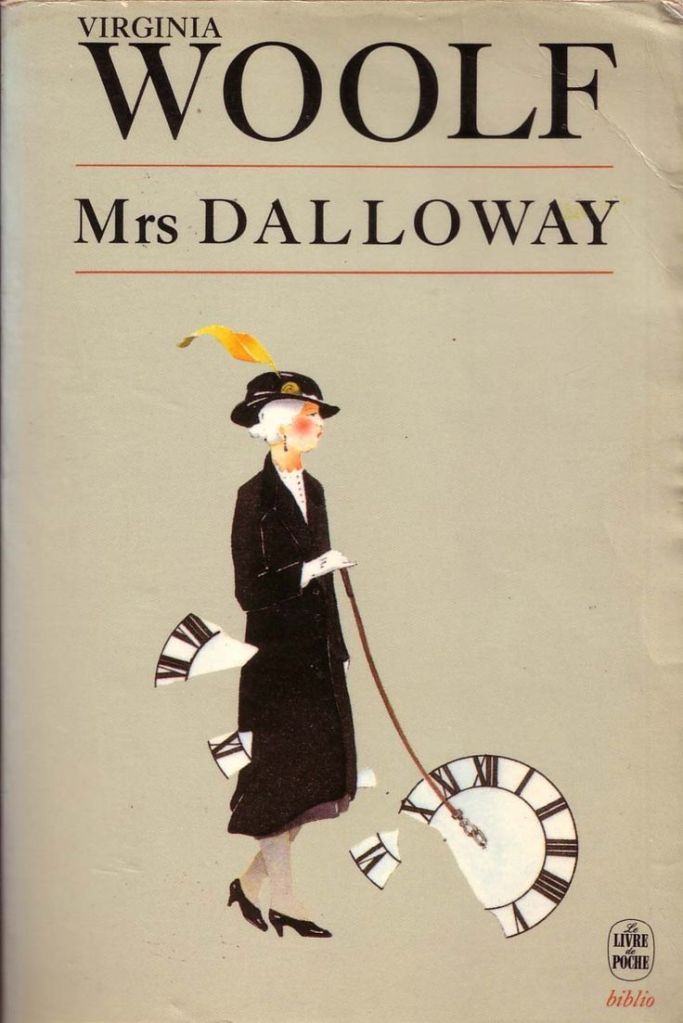
In line with the modernist tradition, Virginia Woolf represents the two different personalities struggling inside her schizophrenic mind by the fragmented subject of Clarissa Dalloway and Septimus Warren Smith. Woolf reveals her own androgyny by thus crossing the boundaries of gender.
Like most visionary artists, including Virginia Woolf, Septimus has a different perspective on the world. As a World War I veteran, having lost his friend Evans in battle, Septimus ‘feels a growing alienation incompatible with Victorian morality, optimism and convention’. (Britannica Concise Encyclopedia on Modernism). Industrialization and urbanisation, together with a changed sociological insight thanks to Darwin’s evolutionary theory and Freud’s theories of the unconscious, plunge him into crises and fragmentation and eventually render him mad. His resemblance to Virginia Woolf is enhanced by the regular hearing of voices and the suffering of severe periods of depressions.

Opposed to this behaviour usually looked upon as insanity stands the sanity reflected in the upper middle class woman of the 1920s, in this case Clarissa Dalloway. Married to attempting politician Richard and mother of a daughter named Elisabeth, Mrs. Dalloway – no longer Clarissa – can not fully explore all the facilities of her personality, most notably, her slumbering love for women.
After the consternation by the trial and subsequent imprisonment of Oscar Wilde in the 1890s (Wisdom, R. 1998. “Oscar Wilde’s 1895 Martyrdom for ‘Indecent Acts’”. People with a History – An Online Guide to Lesbian, Gay, Bisexual and Trans* History.), set alight by the insulting attempts of the Marquess of Queensberry to keep Wilde separated from his son Lord Alfred Douglas, publicly asserting one’s homosexuality was sure to be an impudent collision with reigning moral codes. (E. M. Forster for instance, himself a concealed homosexual until death, would only have his 1913 novel Maurice, on the life of an explicitly gay male protagonist, published posthumously in 1971.) Clarissa Dalloway could therefore never hope for a long-lasting relationship with her adolescent love Sally.

Virginia Woolf too seemed to be in distress by an indecisive sexual orientation, perhaps due to the sexual abuse she suffered from her half-brothers George and Gerald during childhood. Although happily married to Leonard, their marriage is said to have never been fully consummated. However, as members of the highly controversial Bloomsbury group, cross-matrimonial affairs were a common cause within the Woolf family, which enabled Virginia to indulge in her love for women such as Vita Sackville-West.
Both Septimus and Clarissa are trapped in a moment of time in the past. Septimus, who suffers from endless hallucinations about the death of his friend Evans during the war years, can not let go of his oppressive and shattered view on mankind and decides to kill himself. Clarissa, on the other hand, remembers the past as beautiful in her reveries on an adolescent summer at Bourton, and her flourishing love for Sally. Septimus needed to die for her to appreciate life more. Life for Clarissa consists of moments of happiness, which she situates mainly in the past. Compared to these, her present life seems fairly trivial. Being haunted by memories and chances not taken as part of the questioning of the self is characteristic of the modernist questioning of 19th century truths in general. With nothing to go by, every unlucky choice can direct your life into a fatal course, which makes Mrs. Dalloway feel ‘that it was very, very dangerous to live even one day’. (Woolf, V. 1925. Mrs. Dalloway. Penguin Books Ltd., London, 1996, 11)
Within postmodernism, however, this uncertainty and multiplicity is experienced as positive. Since postmodernists consider there is no objective reality, different possibilities can be explored. According to Federman (Federman, R. 1975. Surfiction: Fiction Now and Tomorrow. Ohio University Press, Ohio, 1981.), this changeable and unpredictable identity is in fact ‘more genuine, more complex, more true-to-life’. In The Hours, alternative versions of Mrs. Dalloway are shown by means of the multiple subject of the three women, each dealing with their homosexuality in different ways.
Virginia Woolf once kissed her sister and explores the possibility of an alternative love life in fiction by imagining a kiss between her main character Clarissa Dalloway and Sally. In the 1950s, housewife Laura Brown is reading Woolf’s Mrs. Dalloway. With a toddler boy Richard and pregnant of a second child, she is trapped in an oppressive marriage, overly protected by her patronising husband. All her ambitions have been smothered, because the world has no other expectations of her than just to be there for her family, and bake an occasional birthday cake:
‘Why, she wonders, does it seem that she could give him anything, anything at all, and receive essentially the same response. What does he desire nothing really, beyond what he’s already got? (…) Her cake is a failure, but she is loved anyway. She is loved, she thinks, in more or less the way the gifts will be appreciated: because they’ve been given with good intentions, because they exist, because they are part of a world in which one wants what one gets’.
(Cunningham, M. 1998. The Hours. Farrar, Straus and Giroux, New York, 1998, 100-101).
When Kitty, the self-confident neighbour arrives and breaks into tears because she might have cancer of the womb, Laura comforts her, and when they embrace, she warmly kisses her. They both panic, and Kitty runs off like nothing has happened. Laura feels utterly confused and considers suicide (struck by the idea while reading Mrs. Dalloway), but in the end she chooses life instead of death and decides to leave her family and move to Canada once her second child is born. Her eldest son leads us to the third women, a contemporary Mrs. Dalloway. Richard Brown once shared a romance with this Clarissa Vaughn, a book editor in present-day New York. Clarissa has been living together with her partner Sally for more than a decade now, and the both of them raise a daughter from an unknown father.
These three generations of bisexual women seem to have gradually become freer to express their sexuality. Without the tour de force of Virginia Woolf writing Mrs. Dalloway, Laura might not have left her husband, and Clarissa Vaughn would not have been able to break completely with patriarchy. Remarkably favourable, however, is the way in which Stephen Daldry does not idealize homosexual love either. While Clarissa Dalloway was trapped in a dull marriage with Richard Dalloway and cherished her youthful homosexual experience with Sally as a unique moment of happiness, Clarissa Vaughn, living together with Sally, experiences this relationship to be as routine and uneventful as any other heterosexual relationship and is filled with nostalgia for rebellious times gone by with Richard Brown. She tries to imagine what her life could have been like had she remained with Richard, cherishing the past, which seems so much more exciting than her present trivial life:
‘It had seemed like the beginning of happiness, and Clarissa is still sometimes shocked, more than thirty years later, to realize that it was happiness (…) There is still that singular perfection, and it’s perfect in part because it seemed, at the time, so clearly to promise more.’.
(Cunningham, M. 1998. The Hours. Farrar, Straus and Giroux, New York, 1998, 98)
As Michael Wood (Wood, M. 1998. “Parallel Lives”, The New York Times.) claims, ‘reflection is where many of our chances for happiness lie, in the memory not of what happened but of what was promised’. But, as Clarissa’s daughter points out, feeling alive and beholding glimpses of promising futures is exactly what shapes the bliss of youth. Once growing older, following certain paths inevitably leads to count out other opportunities. Nevertheless, put into perspective through the postmodern view, a certain course of life is only one of the options, neither better nor worse than any other possibility. As Richard Brown said to Clarissa, whether living with a man or a woman, people need to let go of their past and start to make the most of the life they have chosen.
This essay was originally written in 2008 during a course on English Literature and Cinematography at the University of Barcelona.
Read more:
- Cuddy-Keane, M. 1996. “Mrs. Dalloway” and “Reading Group Guide”. Hal Hager & Associates, New Jersey, 1996. The International Virginia Woolf Society.
- Fairfield, S. 2001. “Analyzing Multiplicity: A Postmodern Perspective on Some Current Psychoanalytic Theories of Subjectivity”. Psychoanalytic Electronic Publishing. Psychoanalytic Dialogues.
- Gussow, M. 1999. “A Writer Haunted by Virginia Woolf”. New York Times.
- Marschall, G. 1998. “Modernism”. Oxford University Press. A Dictionary of Sociology.
- Merriman, C. D. 2007. “Virginia Woolf”. Jalic Inc. Virginia Woolf – Biography and Works.
- “Modernist Literature”. Wikipedia, the free encyclopedia.
- 2007. “Multiple Personality”. Columbia University Press.The Columbia Encyclopedia, Sixth Edition.
- “Postmodern Literature”. Wikipedia, the free encyclopedia.
- “Postmodernist Film”. Wikipedia, the free encyclopedia.
- My essay on marriage in Virginia Woolf’s To The Lighthouse
 Kirsten Malfroid
Een gedachte over “Postmodernism on Homosexuality in Mrs. Dalloway”
Reacties zijn gesloten.